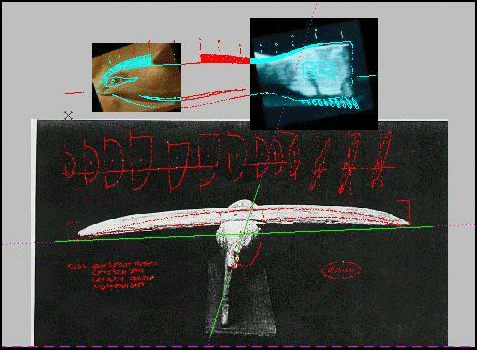
The Saqqara Bird in all its glory.
Specifically, there's no small number of folks out there who'd have you believe that the Saqqara Bird is a functional glider, or perhaps even a prototype model for a full-scale airplane. Nearest I can tell, the first person to claim that the bird was a model/prototype aircraft was Dr. Dawoud Khalil Messiha back in 1969, but the claim may have been most famously made by Hunter Havelin Adams III in the notoriously specious essay African and African American Contributions to Science and Technology. 1 On pages 52 and 53 of this essay, Adams claims
The ancient Egyptian model looks contemporary and bears a strong resemblances to the American Hercules transport aircraft...[Although the glider] could sail through the air for a considerable distance with only a slight hand thrust it definitely was not a toy. It was a model for a full-scale glider! ...[Another source claims that] Egyptians used their early planes for travel, expeditions, and recreation!Wait...what? The Saqqara Bird looks like a Hercules C-130? A Hercules C-130 is 97 feet long, and has four 4,300 horsepower engines. The Saqqara Bird is about seven inches long and doesn't even have a horizontal stabilizer on its tail. It looks like a modern plane only in the sense that it has wings. I'm also curious to know who Mr. Adams' source can make bold assertions about how the ancient Egyptians used their airplanes when we have nothing in the way of evidence that they had airplanes to begin with.
The History Channel, as part of it's continuing plan to completely discredit itself, recently ran an episode of the show "Ancient Discoveries" which purported to prove that the Saqqara Bird was capable of flight. Have a look.
Wow - those guys put a model of the bird through a wind tunnel AND a computer simulation and they say it can fly! That's conclusive proof, right? Wrong. Watch the video again and pay attention - these guys aren't testing the Saqqara Bird, they're testing a balsa wood model fitted with a large horizontal tail surface. The real bird has no horizontal tail at all and is made from sycamore, which is something like three times as dense as balsa wood. The real conclusion here is that if the Saqqara Bird was made of different material and actually shaped like an airplane, it could fly. How much does that prove?
 This is Big Fluffy Puss-Puss, and he can fly...
Or he could, if only he were shaped like this:

More to the point, a few years ago model airplane enthusiast Martin Gregorie tested the flight capabilities of a model of the Saqqara Bird and his results were far less less enthusiastic. Unlike our friends with the History Channel, Gregorie notes that the original bird's wings are of unequal length and are not level with the rest of the body and the vertical tail is actually set at an angle. 2 Take a look at this picture and see for yourself. In order to get a more thorough picture of the bird's potential capabilities, Gregorie experimented with various slightly different configurations for the object's wing and tail structures. He fashioned two wings for his model, one that was curved like the original bird's (which he calls a "scale wing") and one which was flat. He also created two horizontal tail surfaces, a "scale tail" shaped like the wings of the original bird, and a "big tail" that was flat and, er, big. He also experimented with adding additional ballast to the model.
Gregorie's conclusion when launching the model without an added tail surface was as follows:
The model will not fly without a tail...The result is always a pitch up if the model is launched at its gliding speed and a pitch down if launched faster, followed by a tumbling motion. Adding ballast to the nose to move the balance point forward has no effect.He found that the "scale wing" (which, as you'll recall, closely mimics the wing of the original bird) is somewhat less effective than the flat wing at sustaining a glide, noting that "the scale wing section is rather inefficient and the anhedral built into it makes the model laterally unstable." Directly refuting the earlier claim that "the model could soar through the air with only a slight hand thrust" Gregorie states that:
Even unballasted, the model's flying speed is fairly high. It does not soar and cannot be launched "with a slight jerk of the hand"...Attempts to do so merely result in the model flopping to the ground in a level attitude. It needs a full-arm launch at a fairly high speed to fly at all.His final conclusion consists of three simple bullet points and reads thusly:
- The performance of this model proves conclusively that the Saqqara Bird never flew. It is totally unstable without a tailplane. A cursory inspection of the photos shows that it never had one.
- Even after a tailplane was fitted the glide performance was disappointing. The Saqqara Bird was certainly never a test piece for a low speed, cargo carrying aircraft.
- The model makes an excellent weather vane. It points directly and steadily into the wind and does not veer from side to side.
Saying that the Saqqara Bird could possibly have been an ancient weather vane may not be nearly as exciting as claiming that it was the prototype for an Egyptian airplane, but it's almost certainly closer to the truth
______
1.) The Adams essay is especially troubling because it was distributed to schoolchildren as part of a series of essays about African and African-American history. An extreme Afro-centrist, Adams was willing to throw legitimate African-American scientific contributions under the bus in favor of grandiose pseudohistorical nonsense. See this Skeptical Inquirer article to a full discussion of Adams' bizarre claims.
2.) Gregorie notes that the unequal length of the wings may be due to breakage and subsequent reassembly of the bird.